Tuesday, October 16, 2007

floorboards

my floorboards are 1/4" Baltic Birch plywood.   I used the aluminum floorboards as a pattern, cutting the plywood on the bandsaw.  A 1/4" X 3/4" spruce strip joins the two parts of the floorboards.  The only real trick to making them is getting the "bow" in the plywood pieces.  I used 8X8X16 concrete blocks as weights, 2X4 blocks, and soaked the plywood for several hours in water.


The brake heel plates are fabricated of .050 aluminum sheet and screwed in place with 3/8 SM screws.

The floorboards are installed one at a time with #8 screws and locknuts after four coats of varnish, 2 coats of traditional spar varnish and 2 of epoxy varnish, light sanded between coats

.

And then the kick panel (also 1/4 plywood) is added under/infront of the seat.

Return to Index

Monday, April 30, 2007

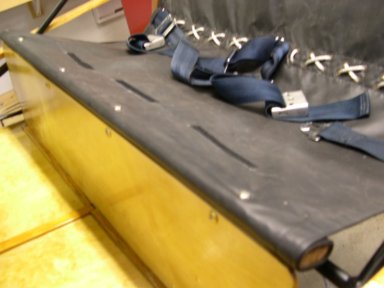
seat sling


The seat with cushions and seat belts.


Shown above is the "spider" that attaches the seat belts to the frame.

I sewed 6 Velcro loop strips to the seat sling...and six Velcro hoop strips to the cushions to hold the cushions in place. 

The seat sling itself is then laced onto the spider using a shoelace type pattern.

And then the seat sling is rolled onto the front "seat adjustment" batten and screwed to the steel framework above the kick panel. 

Return to Index

Wednesday, February 7, 2007

Glove box

Taylorcraft glove boxes seldom survive.  They are often removed in favor of "modern" radios and instruments.  And, the original glove boxes were made of cardboard    so if they got wet or received rough handling they were destroyed. 

Following suggestions from Tailorcraft owners, the glove box is long enough to hold a sectional chart flat, it is cut away in the top front ends to clear the boot cowl, and the front end is sized to hold two 6V. lantern batteries.  I made my glove boxes of thin fiberglass over an aluminum tray (Photo 1).  I first made a mold (real moldmakers would call this a "plug") from 3 pieces of 2X6 bandsawed to shape and glued together (Photo 2).  I used two layers of boat cloth and polyester resin. 

Next, I made door springs using the "How to Make Springs" website and a photo that Keith sent me.  The spring is 15 turns of .025 music wire. (Photo 3)  I first made some simple tooling...a 1/8 mandrel held in the chuck of a drill, and a forming tool made of a 1/2 x 1/8 x 12 bar with two holes in it.  The first hole is slightly over 1/8 so the mandrel can turn inside it, and the second hole, about 2" behind the first, is sized to tightly hold a 1/8 pin.  (Photo 4)  To make the springs, the forming tool and the music wire are held in the right hand while the left hand operates the drill.  About $2 worth of music wire will make a dozen springs in just a few minutes.  Photo 5 shows a spring installed in a hinge.

I also made glove box doors of .032 aluminum sheet.  Photo 6 shows the setup consisting of two oak blocks with the 5 x 7 aluminum sheet clamped between.  The block behind the aluminum has a radius filed onto three sides.  A rawhide mallet is used to hammer the aluminum down around the radius.  (Photo 7)

Return to Index


Tuesday, January 23, 2007

Brake Cables

Taylorcraft brakes are, of course, mechanical brakes actuated by cables.  The original size of the cables is a matter of some discussion.  Some say 1/16" cables were original, others say 3/32".  Adding to the confusion is the fact that most "T"s are now equipped with 1/8" cables which are standard for all other controls.  But the fact is the cables need to be quite flexible to go around those little steel pulleys...and 1/8" is just too large.  Then there's the reports of 1/16" cables breaking...breaking strength of 1/16" cable is 480 lbs., but one can easily imagine a panic stop with a 200 Lb. pilot stomping up to, well, 480lbs resulting in brake failure.  That leaves 3/32" cables, delightfully flexible in the 7X19 version with an astounding 1000 lb. breaking strength!

The cables are connected to the pedals with adjustable cable clamps.  Behind the pedals, the parking brake is connected with another cable clamp. (see Photo 1)  At the wheel, the cables are connected to the brake bellcrank with a nico press sleeve and thimble...and two steel links.  (see Photo 2)


Return to Index

Tuesday, January 2, 2007

Fairleads, Cable Guides

These fairleads are usually called cable guides, although they do the same job as the round kind.  The T-Craft has 4 cable guides, two 3 holers as shown in Photo 1, and two single holers.  They serve to route the elevator and rudder cables around the cockpit.  My project T had the right front cable guide missing...it is the one that gets the most wear and gives the most friction (due to the angle of the cables at this point).

But it's easy to make a duplicate part.  Cut two identical blocks of 1/4 thick phenolic using an old cable guide as a pattern.  Then drill the mounting holes 3/16".  Bolt the two blocks together and then drill the 3 guide holes down the center. (Photo 2) The drill bit will tend to follow the seam between the blocks giving two nice half-holes in each block.

Return to Index

Link to Fairleads, Phenolic

Monday, January 1, 2007

Fairleads, Phenolic

Nylon fairleads are easy and all "modern" looking.  But phenolic is original.   And lighter, and cheaper.  (Well, they're cheaper only if you ignore the labor required to fabricate them!)

I got my fairleads from Mark Julicher for $10/dozen.  They are simple sections of phenolic pipe and require some minor machine work to finish them.  All operations are easily done on a cheepo made-in-China drill press and some simple tooling.

I made fairlead mounting fixture for the drill press (Photo 2) by cutting the head off a AN3-15 bolt, drilling a 3/16 hole in a short piece of 5/8 dowl, a couple of washers and a AN365 nut.  Then I used a strip of plumbers sandpaper (Photo 3) wrapped around the fairlead to polish it down to around .790 outside diameter...a nice fit.

Then I used a 5/8 rotary rasp to open up the inside diameter (Photo 4).  (Test the fit by pulling a control cable through.)

To cut the retainer ring grooves, I made a "cup" fixture (Photo 5) from a piece of one inch steel tube with a washer soldered in one end.  The cup covers most of the fairlead but leaves about 1/8 of one end exposed.  The groove is cut with a hacksaw blade bearing against the phenolic and located by the cup fixture. (Photo 6).  Turn the fairlead around to cut the groove in the other end.

The resulting fairleads are identical to the original fairleads except for the fresh pink color. (Photo 7)

Return to Index

Link to Fairleads, Nylon

Thursday, November 30, 2006

Control Cables

Inspect those cables.  The traditional method is to rub a rag the length of the cable...if the rag snags on a loose wire, replace the cable.  But really, ALL the cables on the entire airplane can be replaced for less than $100 and a bit of your own labor.  So why not treat the old girl to a new set of control cables?!

The tools required are modest (Photo 2).  A cable cutter, some thimbles, nicopress sleeves, and a swedge-it tool.  The swedge-it tool comes with a go/no-go gage or you can use a calipers to check the finished swedge.  Order enough cable, plus a little extra.  The Taylorcraft uses all 1/8" 7X19 galvanized cable...about 150 feet total.  You can buy genuine aircraft cable for about the same price as the hardware store stuff, so don't cheap out on the cable quality!

First cut off the old fittings.  (Photo 3) shows a bushing being cut off with a hacksaw.  Then tape the old cable side by side to the new cable.  Keeping the old and new cables taped together (Photo 4) until the terminations are complete will ensure that the new cable will come out exactly the same length as the old cable.

Wrapping the cut point with a couple turns of masking tape will keep the cable strands from spraying out when cut with the cable cutter (Photo 5)

Run the cable through the nicopress sleeve, around the thimble, through the turnbuckle end (if used!), and then back through the nicopress sleeve.  Allow 1/8 to 1/4 inch of the cut end to protrude through the sleeve.  (photo 6)  The sleeve expands lengthwise as it is swedged, so it will tighten the cable around the thimble and reduce the length of cable end protruding out of the sleeve. 

Then insert the thimble, end, sleeve, cable assembly into the swedge-it tool (Photo 7) and complete the swedge following the directions that came with the tool or from AC43.13.

Finally, check the completed swedge with the go/no-go gage (Photo 8)

Return to Index